
There’s a moment that catches so many of us by surprise in our late 30s or 40s, and it often arrives quietly.
You’re not sick.
Your labs come back “normal.”
You’re eating clean, lifting weights, taking your supplements, prioritizing sleep.
On paper, you’re doing everything right for healthy aging.
And yet… you feel run down.
The energy you used to rely on, the kind that carried you through a full day and still left room for joy, creativity, and connection, just isn’t there anymore. For me, it felt like I was still showing up, but running on fumes. I could push through, check the boxes, handle the day… but I had nothing left over for the things that actually mattered.
I wasn’t crashing.
I was fading.
Quietly. Slowly. In a way that didn’t make sense.
That was the moment I realized something deeper was going on, something beneath my “healthy habits” and normal labs. And if this feels familiar, I want you to hear this clearly:
You’re not failing.
Your lifestyle isn’t failing.
You’re in a biological transition that changes how your body creates and uses energy at the cellular level.
Healthy Aging Starts With Energy, Not Willpower
Here’s something I say often, especially in midlife:
When you have energy, you have access to your full self.
Not just the energy to get through your to-do list, but the kind that allows you to:
→ Be present with your kids or partner without feeling like you’re about to lose it
→ Feel like yourself after the workday ends
→ Think clearly, move confidently, and actually enjoy the life you’re building
That kind of energy doesn’t come from motivation or discipline. It comes from your cells, specifically from your mitochondria.
Mitochondria are the tiny power plants inside nearly every cell in your body. Their job is to convert the food you eat and the oxygen you breathe into ATP, the energy currency that powers everything you do.
Every heartbeat.
Every thought.
Every muscle contraction.
Every deep breath.
Healthy Aging and Mitochondria
Your brain, heart, liver, and muscles are especially rich in mitochondria because they demand so much energy. When mitochondrial function slows down, you feel it everywhere.
For me, that persistent “running on empty” feeling wasn’t about being busy or getting older. My cells were simply producing less energy. Workouts that used to energize me left me depleted. My mood felt fragile. Clear thinking felt like wading through fog.
Once I connected the dots, everything changed.
The Estrogen–Energy Connection No One Talks About
Here’s something I wish every woman knew before her 40s:
Estrogen doesn’t just regulate your cycle or fertility. It protects your energy.
We’re taught to think of estrogen as a reproductive hormone, but it plays a powerful role in healthy aging by supporting mitochondrial function, defending against oxidative stress, and improving recovery from physical and emotional strain.
So what happens when estrogen begins to decline, as it does in perimenopause?
Your mitochondria lose that protective buffer.
And that’s when many women experience a deeper, more persistent exhaustion, one that sleep, caffeine, and even clean living don’t fully fix.
This isn’t laziness.
It’s not a lack of discipline.
It’s biology.
When you understand this, you can stop blaming yourself and start supporting your body in a smarter, more compassionate way.
“I’m Doing Everything Right, So Why Am I Still Tired?”
I hear this question all the time.
You’re eating well.
Strength training.
Managing stress.
Drinking your water.
Prioritizing sleep.
And yet… you’re still tired.
Here’s the truth: your habits are working. They matter deeply for healthy aging.
Exercise stimulates new mitochondrial growth.
Whole foods reduce oxidative damage.
Sleep allows cellular repair.
Stress care protects your hormones.
These are non-negotiables, and I’ll teach them forever.
But here’s what I had to learn the hard way: even the best lifestyle doesn’t fully address what’s happening inside your cells as you age.
There’s a specific cellular process that becomes increasingly important in midlife, and almost no one talks about it.
Healthy Aging Requires Cellular Cleanup
That process is called mitophagy.
Mitophagy is your body’s way of clearing out old, damaged mitochondria so healthier, more efficient ones can thrive. Think of it as spring cleaning for your cells.
Without mitophagy, it’s like building new machines in a factory while leaving the broken ones piled up on the floor. Eventually, everything slows down, even if you’re doing all the “right” things.
So if you’ve felt like lifestyle alone isn’t restoring your energy, strength, or mental clarity, you’re not imagining it. There’s a biological gap that needs addressing.
Healthy Aging Relies on Mitophagy
Mitophagy becomes increasingly important as we age because damaged mitochondria naturally accumulate over time, especially during periods of hormonal transition like perimenopause.
When this cellular cleanup process slows down:
- Energy production becomes less efficient
- Muscles fatigue more easily
- Recovery takes longer
- Brain fog becomes more common
Supporting mitophagy helps restore cellular efficiency, which is a foundational pillar of healthy aging. It allows your cells to function more like they did when energy felt effortless, without requiring you to push harder or do more.
Why Food Alone Isn’t Always Enough for Healthy Aging
Your body can trigger mitophagy through a compound called Urolithin A. Here’s how it’s meant to work:
→ You eat foods rich in ellagitannins, like pomegranates, berries, and walnuts
→ Your gut bacteria convert them into Urolithin A
→ Urolithin A signals your cells to clean out damaged mitochondria
It’s a beautiful system, in theory.
But here’s the catch:
Only about 40% of people have the gut bacteria needed to make this conversion efficiently.
You’d need unrealistic amounts of these foods daily.
Perimenopause itself can disrupt gut health, making the process even less reliable.
So if you’re eating well and still not feeling the energy return, it’s not your fault.
This is where targeted, evidence-based supplementation can support healthy aging, not as a replacement for lifestyle, but as a strategic complement.
What I Added (Only After Doing My Homework)
Lifestyle is the foundation. Always.
But I’m also honest about where lifestyle ends and where smart tools can help fill real biological gaps. When I started learning about Urolithin A, I asked the questions I always ask:
Is it backed by human research?
Does it do something food alone can’t?
Does it support real markers of healthy aging?
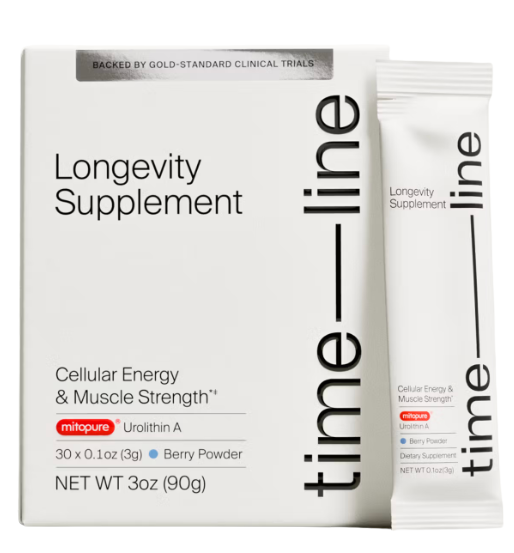
That’s why I chose Mitopure®, a clinically tested form of Urolithin A. I added it to my own protocol because it supports cellular renewal in a way I couldn’t fully achieve through lifestyle alone.
What The Research Says
Mitopure has been studied for over 15 years, across 11 clinical trials and more than 900 participants. Research shows:
→ A 39% increase in mitochondrial renewal after 16 weeks
→ A 12% improvement in muscle strength
→ Improved cellular energy markers, including ATP production
→ Better exercise performance and recovery
That strength improvement isn’t about vanity. It’s about protecting functional independence as we age.
Muscle is your longevity insurance, and mitochondria power every movement you make.
Healthy Aging Is a “Yes, And” Approach
This isn’t about either/or.
Your habits still matter:
Nutrition provides the building blocks
Exercise builds new mitochondria
Sleep allows repair
Stress care protects hormones
Mitopure supports the cleanup process that allows all of those systems to work better together. That’s how we work with our biology, not against it.
Why I’m Sharing This
I only share what I personally use and believe fills a real gap. After taking Mitopure consistently for months, I’ve noticed subtle but meaningful shifts in energy, strength, and resilience.
Healthy aging isn’t about chasing youth.
It’s about protecting your strength.
Preserving your spark.
Staying connected to yourself.
Aging is inevitable. Losing yourself in the process is not.
When your cells are strong, you’re strong, and that’s how we rewrite what’s possible in midlife and beyond.
I’m excited to say share my personal discount with you today: 20% off with code MARIZA >>

No comments yet.